


A Detailed Analytical Summary of “Ethiopia’s Role in the Horn of Africa: Four Possible Scenarios”
Introduction by the Horn of Africa Center for Policy
The Horn of Africa Center for Policy presents this detailed analytical summary of the policy brief issued by the Ethiopian Institute of Foreign Affairs (IFA) in 2024, titled “Ethiopia’s Role in the Horn of Africa: Four Possible Scenarios.”¹ This significant publication was prepared by a team of researchers and experts, including Henok Getachew, Gahaw Ayferam, and Ambassador Rashid Mohamed.² This analysis comes at a pivotal moment for Ethiopia and the entire Horn of Africa region, where internal challenges are intertwined with shifting regional and international dynamics, putting Addis Ababa’s historical role as a regional power to the test.
This extended summary aims to review and analyze the profound ideas and insights presented in the report, deconstructing the foundations upon which the proposed future scenarios are built. We will endeavor to provide a comprehensive reading of the dilemmas facing Ethiopian policymakers and how the country’s foreign policy trajectory is no longer merely an extension of its national will, but the product of a complex interplay between its internal conflicts, the ambitions of its neighbors, and the interests of international powers. Understanding these multiple dimensions, as presented in the IFA report, is vital for every observer of this strategic region of the world.
Part I: The Crisis of Ethiopian Hegemony: From Anchor State to a Quest for Legitimacy
By virtue of its demographic weight, geographical size, and strategic location, Ethiopia has long been considered an “anchor state” in the Horn of Africa region.³ This role was based on a combination of factors, including its internal willingness to project power, its military capabilities, and its active participation in regional and international security initiatives, such as the “War on Terror” and peacekeeping operations.⁴ However, the IFA report indicates that this dominant role is now facing unprecedented erosion, and Addis Ababa finds itself in a dual struggle that extends beyond the mere projection of material power to a “struggle to generate trust and legitimacy.”⁵
1. Internal Fissures: The Depletion of Capabilities and State Erosion
The report places internal challenges at the heart of the crisis of Ethiopia’s regional role. The devastating conflict in the country’s north was not just a fleeting security crisis; it had profound structural repercussions that “sapped the potential of the state.”⁶ The war led to the large-scale consumption of economic and military resources and preoccupied Ethiopian diplomacy with peripheral battles to defend its position rather than focusing on constructive regional initiatives. Although the peace agreement reached in Pretoria and Nairobi between the Ethiopian government and the Tigray People’s Liberation Front (TPLF) formally ended the crisis associated with the conflict,⁷ its consequences remain evident.
But the crisis is not confined to the north. The report notes that “different pockets of the country,”⁸ especially in the “western and central parts of Ethiopia,” are witnessing an escalation of conflicts and the resulting humanitarian problems.⁹ These “ethnic-based insurgency movements” directly challenge the state’s “monopoly on violence,”¹⁰ which is a cornerstone of any state’s sovereignty. This erosion of central authority not only weakens Ethiopia from within but also undermines its image abroad as a stabilizing factor, gradually transforming it from a “provider of security” to a “recipient of security assistance,”¹¹ thereby limiting its capacity to play any leading role.
2. Diplomatic Isolation: The Deterioration of Regional and International Relations
The challenges were not only internal but also extended to Ethiopia’s foreign relations. The report highlights the “troubled diplomatic relations Ethiopia has had with the Sudan and Egypt on the utilization of the Nile River”¹² as one of the most prominent sources of regional tension. The issue of the Grand Ethiopian Renaissance Dam (GERD), despite its national importance to Ethiopia, has led to sharp polarization in the region and hindered constructive cooperation. Additionally, the report points to the border dispute with Sudan¹³ and Ethiopia’s repeated accusations against Khartoum of “providing support to TPLF fighters and backing the insurgent group in Benishangul-Gumuz region.”¹⁴ These tensions with immediate neighbors create a hostile environment that impedes any Ethiopian ambition to regain its influence.
On the international stage, the “diplomatic position of the Western states regarding the northern conflict”¹⁵ was a major blow to Ethiopia’s standing. Criticisms related to human rights and diplomatic pressure have led to “challenges to its claim of regional position, role(s) and the concomitant identity the state seeks to project.”¹⁶ This “problem of recognition associated with external actors”¹⁷ has weakened Addis Ababa’s legitimacy and provided an opportunity for other regional powers to fill the vacuum. The West, which previously considered Ethiopia a key ally, still possesses “the leverage to constrain the foreign policy choice of the country,”¹⁸ making rapprochement with it an essential condition for any strong Ethiopian comeback.
The relationship between the country’s regional position and the role it seeks to play is one of “mutual reinforcement.”¹⁹ The more its internal and external situation deteriorates, the weaker its role becomes, and the weaker its role, the more difficult it becomes to reclaim its position.
Part II: Future Foresight: An In-depth Analysis of the Four Scenarios
The IFA report presents four possible scenarios for the future of Ethiopia’s role. These are not mere speculations but logical trajectories based on an analysis of the current data. “These four scenarios reflect the possible position of Ethiopia in the region vis-à-vis potential contenders in their bid to achieve their security interests.”²⁰
Scenario 1: A Bipolar Regional Order (Hegemonic Competition between Kenya and Ethiopia)
This scenario assumes that Ethiopia will be able to recover from its “domestic constraints”²¹ and return to the “regional geopolitical space.”²² This return will be driven by progress in the peace agreement and the gradual restoration of stability. However, Addis Ababa will not find the arena as empty as it was before; it will face a strong and determined competitor in Kenya.
The report shows that Nairobi has taken advantage of Ethiopia’s preoccupation with its problems to enhance its own position. It has gained “increasing recognition of the West to the role of Nairobi in the region”²³ and has shown “increasing commitment to project power as recently witnessed in the Congo.”²⁴ The culmination of this rise came through its close relationship with the West, recently culminating in its “recognition as a major non-NATO ally.”²⁵
This competition between the two powers will take multiple forms. The report points to “manifested divisions between the two states regarding the political trajectory in Somalia and South Sudan.”²⁶ This could translate into supporting different factions in local conflicts, competing to lead mediation efforts, or launching rival diplomatic initiatives. If each country considers the other a “rival,” then “shaping the regional order” will face difficulty.²⁷ For Ethiopia to effectively engage in this competition, it desperately needs to “buttress its diplomatic relations with neighboring states and regain the West[‘s] recognition as a regional actor.”²⁸
Scenario 2: The Rise of Nairobi (Kenya Asserts its Hegemony in the Region)
This scenario represents the logical outcome of continued crisis in Ethiopia. If the “difficulty to address the domestic precarious situation in Ethiopia”²⁹ persists, it “will continue to dampen the role the country seeks to play in the region.”³⁰ This weakness will create a power vacuum, and Kenya will be in an ideal position to fill it, provided it is “willing and maintain[s] a healthy diplomatic relations with America and the European Union.”³¹
Kenya’s strength in this scenario is based on a combination of material and non-material factors:
- Diplomatic Legitimacy: The “official narrations of the West are gravitated towards giving legitimacy to the regional role of Kenya.”³²
- Soft Power and Democracy: The “credibility of the 2022 election” is seen as evidence that Kenya is a “beacon of democracy” in a region struggling with democratic transition.³³ This “democracy track record may use as a non-material aspect” that backs its material capabilities.³⁴
- Active Diplomacy: Nairobi’s role in mediation is prominent, with the most significant example being its “hosting the peace deal between the Ethiopian government and the TPLF.”³⁵ If Kenya can “replicate its mediation role in other war-torn states in the region and beyond,” it will bolster its hegemonic ambitions.³⁶
- Economic Strength: The report notes that “Nairobi’s increasing economic performance may also help the country’s desire to wield regional dominance.”³⁷
This scenario implies a significant decline in Ethiopia’s historical role and a decisive shift in the center of gravity in the Horn of Africa southward.
Scenario 3: The Return of Ethiopian Hegemony (Return to the Status Quo)
This is the most optimistic scenario from Addis Ababa’s perspective, but also the most demanding. The report asserts that Ethiopia’s restoration of hegemony “cannot happen in a vacuum”³⁸ but requires “overturning the domestic factors that are compelling Ethiopia to retreat from the geopolitical space it had enjoyed so far.”³⁹
To achieve this, Ethiopia must follow a clear and coherent roadmap:
- Achieve Internal Stability: This is the “sin qua non” (an indispensable condition).⁴⁰ The state must “restor[e] law and order in the conflict-ravaged areas”⁴¹ to recalibrate its regional policy and demonstrate its ability to transition from a “security recipient to a country stand[ing] firm… not merely for its security but also offer[ing] a modicum of security to the region.”⁴²
- Resolve Regional Problems: “Settling the dispute the country has with Sudan over the contested territory could also be considered as a good opportunity to overcome one of the external challenges.”⁴³ Countering Khartoum’s foreign policy strategy aimed at “exploiting Ethiopia’s security vulnerability”⁴⁴ will support Addis Ababa’s drive to reassert its dominance. Without “harmonizing diplomatic relation with the hitherto ‘hostile’ neighboring state,” it would be difficult to augment the country’s relative power position.⁴⁵
- International Rehabilitation: This requires “diplomatic rapprochement with the West”⁴⁶ and “identifying the areas in which the interests of the West and Ethiopia are converged.”⁴⁷ It also involves reactivating participation in peacekeeping operations, which entails “address[ing] its relations with the United Nations,”⁴⁸ especially given reports that future participation of Ethiopian peacekeepers “will be subjected to scrutiny of the human rights records of every deployed soldier.”⁴⁹
- Restore Institutional Influence: “Reviving its influence inside the regional organization (IGAD)” would be an opportunity for Ethiopia’s journey to reassert its influence.⁵⁰ IGAD has historically been a “foreign policy vehicle of Ethiopia” to secure its national interests concerning Eritrea, Somalia, and South Sudan.⁵¹
Scenario 4: A Leaderless Region (A Horn of Africa without a Clear Hegemon)
This scenario assumes the failure of both Ethiopia and Kenya to assert clear hegemony, leading to a regional leadership vacuum. “The region will not have a clear hegemon in that not a single state can play a regional security role with the recognition generated from the external actors.”⁵²
On one hand, Ethiopia will continue to “struggl[e] to overcome internal security predicaments.”⁵³ It “will take time for Ethiopia to recover from full-scale civil war and reinvent itself as a regional actor in the domain of peace and security.”⁵⁴ The “lingering security problem is sapping the capacity of the state,”⁵⁵ and its image as an “anchor state” will remain “tarnished.”⁵⁶ Ethiopia’s “abandoning its leadership role in South Sudan peace process” is cited as an indicator of this decline.⁵⁷
On the other hand, Kenya may lack the “political will to shape regional security dynamics”⁵⁸ and may “refrain from sharing a security burden of the region.”⁵⁹ This vacuum could be further complicated by other factors, as the report notes that “recent geopolitical dynamics over access to the sea outlet may encourage immediate neighbors of Ethiopia to work in league and jeopardize Ethiopia’s drive to escape from geopolitical retreat.”⁶⁰ The final result would be a fragmented and unstable region, lacking an actor capable of leading collective action to address common challenges.
Part III: Grand Strategic Dimensions: The Nile Conundrum and the Red Sea Ambition
Although the IFA report focuses primarily on power dynamics between states, two pivotal policies form an essential backdrop for understanding Ethiopia’s ambitions and challenges: the issue of the Nile waters and the quest for access to the Red Sea.
1. The Nile River: Between National Sovereignty and Regional Security
The report refers to the disputes with Egypt and Sudan over the Nile as one of the key challenges facing Ethiopian diplomacy.⁶¹ The Grand Ethiopian Renaissance Dam (GERD) represents more than just a power generation project; it is a symbol of national sovereignty, developmental ambition, and Ethiopia’s ability to control its natural resources. From Addis Ababa’s perspective, the dam is an inherent right and an utmost necessity to combat poverty and achieve a long-awaited economic renaissance.
However, this project has placed Ethiopia on a direct collision course with downstream countries. The ongoing stalemate in the tripartite negotiations not only affects bilateral relations but also creates a state of strategic uncertainty throughout the entire Northeast Africa region. It drains diplomatic energy, fuels hostile nationalist rhetoric, and prevents the formation of any stable regional bloc. The inability to resolve this complex issue remains a significant constraint on Ethiopia’s ability to exercise a regional leadership role that enjoys the trust and acceptance of its northern neighbors.
2. The Red Sea: An Existential Necessity or a Risky Gamble?
The report astutely notes that “recent geopolitical dynamics over access to the sea outlet” could be a factor in forming regional alliances against Ethiopia.⁶² This alludes to one of the most important drivers of current Ethiopian foreign policy. Having become a landlocked country, reliance on the port of Djibouti has remained an economic burden and a strategic vulnerability.
The determined pursuit of a sea outlet, manifested in recent bold diplomatic moves, reflects a sense of existential urgency within the Ethiopian leadership. But this policy, however logical from a narrow national perspective, carries grave risks. It threatens to inflame tensions with Somalia, raises concerns among other countries in the region, and could complicate Ethiopia’s relations with international powers that prefer to maintain the status quo. This maritime ambition directly intersects with the four scenarios outlined in the report; it could hinder the scenario of restored hegemony (Scenario 3) by creating new adversaries, and it could accelerate the onset of the regional chaos scenario (Scenario 4) if it leads to new conflicts.
Concluding Note by the Horn of Africa Center for Policy
In conclusion, the Ethiopian Institute of Foreign Affairs report provides a comprehensive and insightful vision of the existential challenges facing Ethiopia as it seeks to define its future role in the Horn of Africa. The analysis confirms a fundamental truth: that “adequately addressing the local security problem” is the starting point for any successful regional policy.⁶³ Without restoring internal stability, and without “revisiting a regional strategy that helps the state to recover from domestic and regional conundrums,”⁶⁴ Ethiopia will remain stuck between a glorious past as a hegemonic power and an uncertain future in which it may see its influence wane in favor of rising powers or chaos.
The Horn of Africa Center for Policy wishes to reiterate that this analytical summary aims to present and deepen the understanding of the ideas contained in the original report, for the purpose of enriching academic and political discourse on the future of this vital region. The views and scenarios presented herein are an accurate reflection of the perspective of the original report’s authors
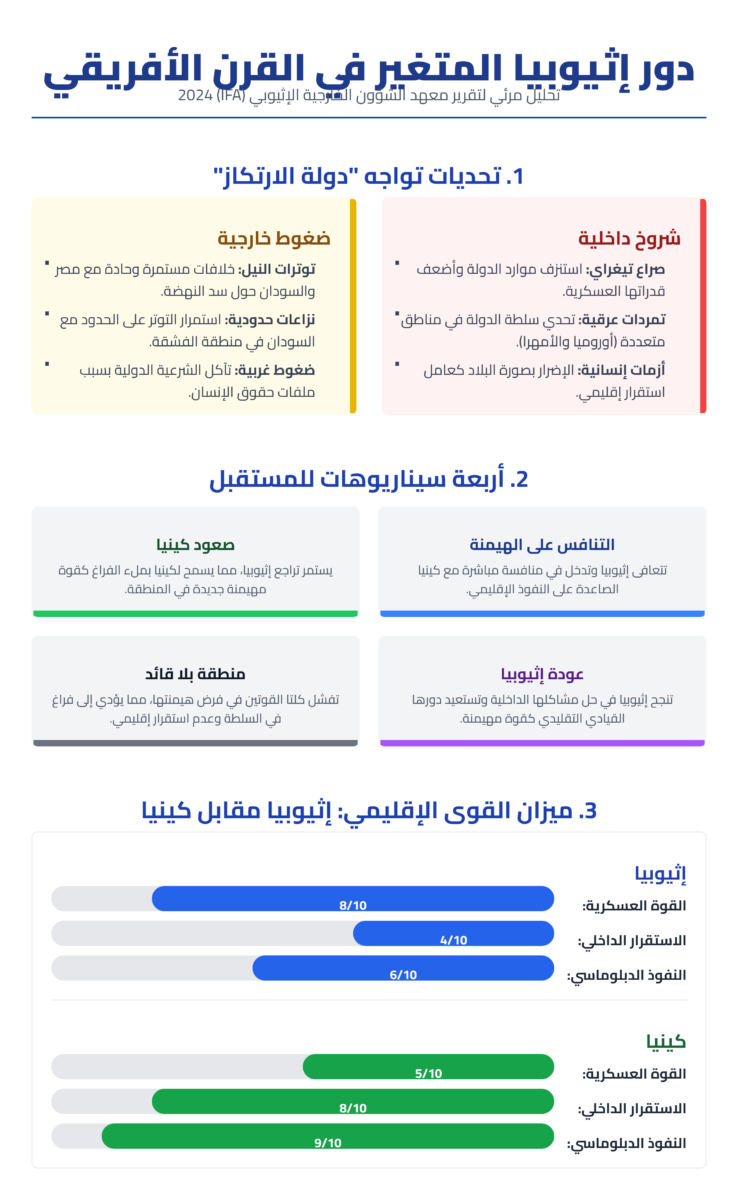
Ethiopia’s Shifting Role in the Horn of Africa
A Visual Analysis of the Institute of Foreign Affairs (IFA) 2024 Report
1. The Crisis of the ‘Anchor State’
💥 Internal FissuresDevastating internal conflicts, particularly in the Tigray region, have sapped the state’s economic and military resources. Escalating ethnic-based insurgencies in other areas further challenge the state’s authority and undermine its image as a provider of security. |
🌍 External PressuresTroubled diplomatic relations persist with Egypt and Sudan over the Grand Ethiopian Renaissance Dam (GERD). Concurrently, pressure from Western nations regarding human rights issues has weakened Addis Ababa’s international standing and legitimacy. |
2. Four Possible Futures
Hegemonic CompetitionEthiopia recovers and enters direct competition with a rising Kenya for regional influence. |
The Rise of KenyaEthiopia’s decline continues, allowing Kenya to fill the vacuum as the new regional hegemon. |
Ethiopia’s ResurgenceEthiopia successfully resolves its internal issues and reclaims its traditional leading role. |
A Leaderless RegionBoth powers fail to assert dominance, leading to a power vacuum and regional instability. |
3. Regional Balance of Power: Ethiopia vs. Kenya
Ethiopia
Military Strength:
8/10
Internal Stability:
4/10
Diplomatic Influence:
6/10
Kenya
Military Strength:
5/10
Internal Stability:
8/10
Diplomatic Influence:
9/10
4. Key Strategic Issues
💧 The Nile ConundrumThe dispute over the GERD remains a primary source of regional tension, draining diplomatic energy and hindering cooperation with crucial downstream neighbors, Egypt and Sudan. |
⚓ The Red Sea AmbitionFor landlocked Ethiopia, gaining sea access is an existential goal. However, its pursuit risks inflaming tensions with Somalia and complicating relations with other regional and international powers. |