


Written by:Omar Ala'meri for "HAPC"
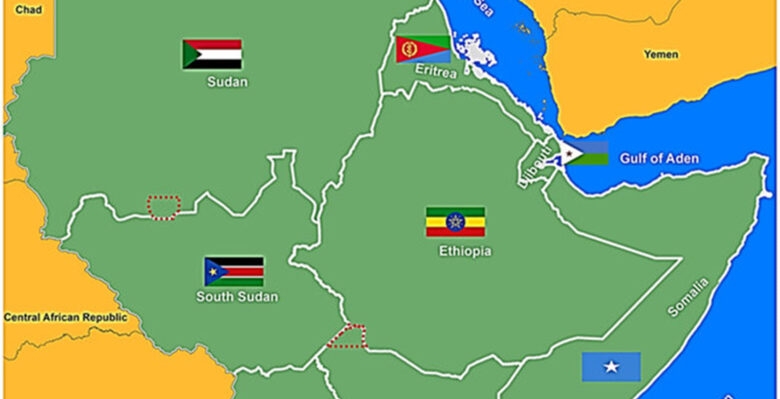
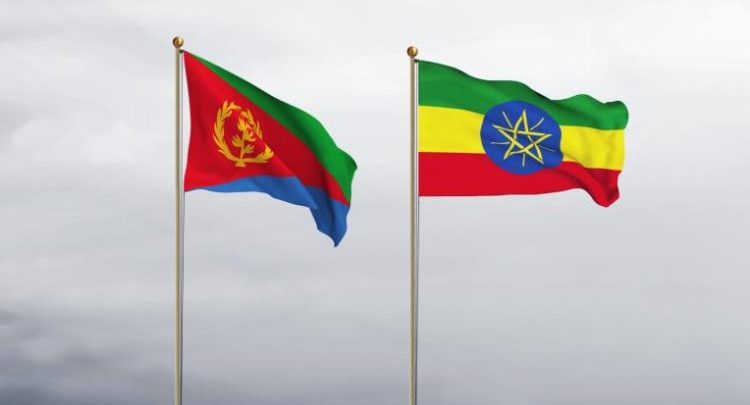
Escalations between Ethiopia and Eritrea continue from time to time, and the latest verbal exchanges between them in recent weeks have been sharp, with accusations being exchanged between the Eritrean and Ethiopian authorities. This is a result of border disputes, with Eritrea claiming that Ethiopia has an increasing ambition to find a sea outlet on the Red Sea. In the same context, Ethiopia responded that the border demarcation that came from the Algiers Agreement of 2000 was unfair, as the port of Assab is originally its own. This prompted Eritrea to use this response as a pretext for military mobilization on the Ethiopian border, continuing to escalate through its political logic towards Ethiopia, and considering what Abiy Ahmed said in response to its political and military escalation as a threat to its sovereignty .
Historical Dimensions Between Ethiopia and Eritrea:
Since the so-called independence movement led by the Eritrean Liberation Front ( ELF ) in 1961, which took Mount Adal as its starting point, Ethiopia annexed Eritrea the following year. The Eritrean movement continued until 1974 when the so-called Ethiopian Revolution took place, where the Derg abolished the Ethiopian Empire and established a Marxist-Leninist communist state with the support of the Soviet Union at the time. One form of support was fighting the Eritreans. In return, the ELF received support from various countries diplomatically and militarily, most notably the People’s Republic of China. From there, political shifts occurred on the part of the supporting parties in favor of Ethiopia, and the ELF was expelled from Eritrea. The Eritrean People’s Liberation Front (EPLF) then exploited the war of attrition against Ethiopia. The Ethiopian government’s loss of support coincided with the collapse of the Soviet Union at the end of the 1980s, allowing the EPLF to defeat Ethiopian forces in Eritrea in May 1991. With the help of the Eritrean Liberation Front (ELF), the groups that founded the People’s Democratic Republic of Ethiopia (PDRY) took control of the capital, Addis Ababa, in April 1993. The new Ethiopian regime allowed the Eritrean people to determine their own destiny through a referendum, which Eritreans overwhelmingly voted for independence from Ethiopia. Official international recognition of Eritrea’s full sovereignty coincided with this year . (1)
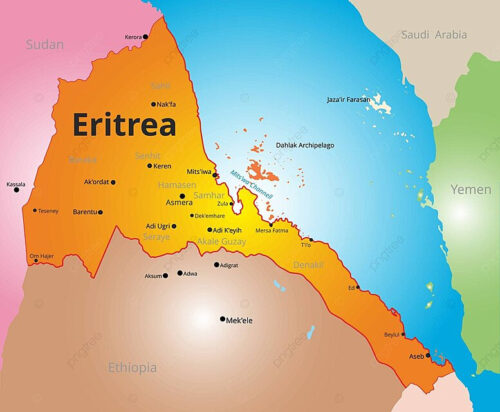
Thus, Ethiopia became a landlocked country. It has no access to the sea since Eritrea ‘s independence from it.
Milestones of the Conflict Between Eritrea and Ethiopia
At the end of the twentieth century, in 1998, a border war broke out between Eritrea and Ethiopia for two years, whereupon the state of Algeria intervened to make peace between them with an agreement in 2000 AD, the most prominent of which was the demarcation of the borders between the two countries, which ended the military conflict that lasted for two years, and the border demarcation committee was indeed established in the same year as an embodiment of the Algerian agreement ( 2).
Tensions persisted between the Eritrean government and the state of Ethiopia, with these tensions being embodied in the Tigray People’s Liberation Front led by the Ethiopian People’s Revolutionary Democratic Front. Irregular ethnic warfare emerged on the border, and the two countries adopted armed opposition groups against each other. This led to the assassination of Meles Zenawi, who served as Prime Minister of Ethiopia from 1995 until his death in 2012. Subsequently, Ethiopia’s attention turned inwards, resulting in the marginalization of Eritrean groups within the country. When Abiy Ahmed assumed office in 2018, Eritrean groups were disappointed by the policies of the Tigray People’s Liberation Front towards them.
Although the rapprochement between the government of Abiy Ahmed and the government of Isaias Afwerki at the end of 2018 seemed to offer a glimmer of hope for achieving peace between the two governments, it soon proved fragile, as the conflict subsequently gained new momentum.
Reasons for the Renewed Political Escalation Between Ethiopia and Eritrea
From 2020 to 2022, Eritrea included forces affiliated with it alongside the Ethiopian Federal Army fighting against the Tigray People’s Liberation Front, which became known as the devastating Tigray War. The war ended with the Pretoria Agreement, which Eritrea considered a marginalization of its role in ending this fragile alliance. Although the agreement aimed to end the irregular war, it unintentionally produced the roots of another conflict.
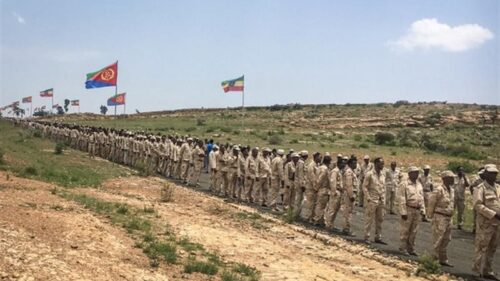
In addition to statements made from time to time by Prime Minister Abiy Ahmed that Ethiopia’s internationally recognized borders with Eritrea are a historical mistake that must be corrected, he stated that Ethiopia could regain control of the port of Assab and that it was only a matter of time , as he put it.
Eritrea, however, considered that statement a direct threat to its sovereignty and territorial integrity. (3)
This is what has exacerbated the crisis between the two countries, and the embers of the crisis may even reach the Red Sea region , and multiple conflicts and parties may erupt in light of Ethiopia’s geostrategic dream of reaching the Red Sea.
Tensions have recently escalated regarding the possibility of a major war breaking out between the countries of the Horn of Africa, while the armed confrontation between Ethiopia and Eritrea is sounding alarm bells .
While the tension between the two countries appears to stem from Ethiopia’s desire to acquire the port of Assab, there are secondary reasons that exacerbate the situation. These include media statements from both sides, the impact of which on strained relations is now evident . On its Independence Day, May 24, the Eritrean government accused Ethiopia of carrying out covert and overt acts of sabotage. In response, Ethiopian Defense Minister Aisha Mohammed and Ambassador Dina Mufti issued condemnations and accusations against Eritrea, warning of continued border violations and interference in Ethiopian sovereignty, which they said could not be tolerated indefinitely .
In recent statements, Ethiopian Foreign Minister Gideon Timotheos called on the Eritrean government to withdraw its forces from what he called Ethiopian territory and to stop supporting what he described as active rebel cells inside Ethiopia, claiming that these Eritrean forces have remained since the Tigray War without any reason. The Eritrean government denied this, describing it as mere allegations.
Is a Military Confrontation Between Ethiopia and Eritrea Probable ?
Analysts say a military confrontation between Ethiopia and Eritrea is unlikely for several reasons, most notably that Ethiopia lacks the military resources to open fronts in the north, as its forces are under strong pressure in Amhara and Oromia.
Another reason why Tigray does not want a new war, even if some leaders do, is that they do.
In addition, there are external demographic pressures. Given the large population growth, especially in Ethiopia, there are concerns about the generation of waves of displacement resulting from the conflict, thus posing a threat to the most important global commercial shipping routes in the Red Sea, not to mention the exacerbation and flow of migration from the Horn of Africa to the Arabian Gulf and European countries.
Due to its diplomatic influence, China has engaged in discreet mediation between the two sides to de-escalate the tense political situation, in order to protect its massive investments in Ethiopian infrastructure. The United States, the European Union, and the Gulf States are also exerting pressure on both sides to prevent any armed confrontation. (4)
There is an even greater reason why war between Eritrea and Ethiopia is unlikely, which is to look at both countries in terms of economic weakness, since the political bickering and squabbling are all embodied in attempts to find ways of development on their respective sides . If war were to break out, both countries would lose the ambition for development , which would then make war absurd in the eyes of both parties, since it is irrational for war to be a means of achieving the strength of a country’s growth.
ـ