


Editing by: HAPC Monitoring Unit:
Date: 3/2026
In light of the current regional escalation represented by the raging war between Iran and the United States of America with Israel, international maritime transport routes have become primarily targeted by the warring parties, disrupting energy supply lines dependent on the ports of the Arabian Gulf and the Strait of Hormuz, which has been completely closed by Iran .
Consequently, Saudi Arabia hastened to divert oil and its derivatives pipelines from its eastern ports to the port of Yanbu, located on the Red Sea coast, as an emergency alternative for energy exports. With this plan initiated by Saudi Arabia as an effective solution to continue energy exports, European powers and the United States began to look forward to adopting the energy transfer project via Israel, according to what Israeli media revealed .
Amount of Energy Exported from Gulf Countries :
The amount of oil and gas exported from the Gulf countries covers a large percentage of the world’s needs, as the Gulf countries’ reserves are estimated at 32.6% of the total global reserves of crude oil, equivalent to 511.9 billion barrels, in addition to 21.4% of the total global reserves of natural gas, amounting to more than 44.195 trillion cubic meters .
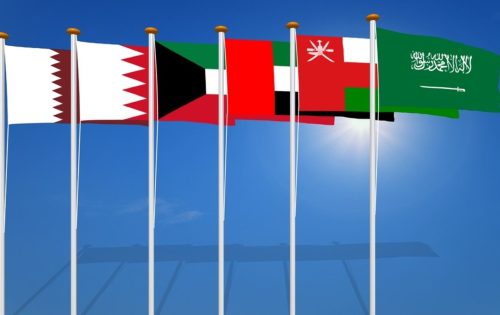
Flags of Gulf Countries
Total daily production reaches 23.2% of global crude oil production, amounting to 17 million barrels per day, and 10.8% of global marketed natural gas production, amounting to 464.2 billion cubic meters.
With these huge proportions and numbers, the importance of the Gulf countries in the global energy market is evident. Therefore, if energy production stops during the current war, the world will enter a deep crisis for global markets, and a wave of paralysis and disruption will occur in the movement of global trade, as the energy crisis will extend to all goods and services to create confusion with the rise in their tax values with the emergence of surges of inflation .
Is the Port of Yanbu Capable of Meeting global Energy Needs?
Kapler , a company specializing in monitoring energy shipments, Yanbu port has witnessed a huge jump in loading and shipping operations during the past weeks, as energy shipments have tripled from 16 million barrels at the beginning of March to 18 million barrels last week, which is three times the amount compared to last February. The amount of shipments through Yanbu port is expected to reach 88.5 million barrels at the beginning of next April, coinciding with Saudi Aramco’s announcement to its Asian customers to assess their ability to import their shipments through Yanbu port instead of the ports of the Arabian Gulf.
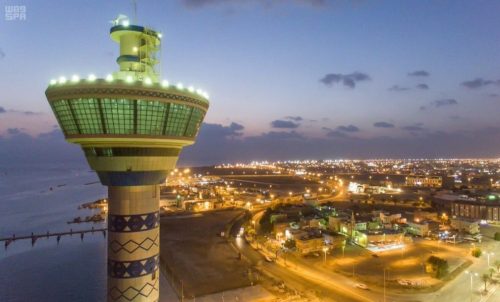
Yanbu Port
This shift reflects the extent of the pressures that geostrategic instability is placing on global trade routes, which has increased the importance of the Red Sea in international navigation by transforming it from a mere international trade route into a global energy supply hub.
As for the port of Yanbu as a permanent option for exporting energy, it is not feasible, because the port of Yanbu will not be a sufficient substitute for all the large and well-equipped ports on the Arabian Gulf, in addition to the increased cost of land transport over the distance via pipelines .
Speculation about European Union and America’s Intention to Change the International Energy Map :
The fact that Saudi Arabia is diverting its energy exports to Yanbu port instead of its eastern ports is not the problem itself, as it will negatively affect traditional shipping routes in the Red Sea. Rather, observers view it as a tremendous step, and evidence of the strength of the Kingdom of Saudi Arabia in possessing strategic solutions to overcome emerging problems and its ability to find alternatives in the shortest possible time.
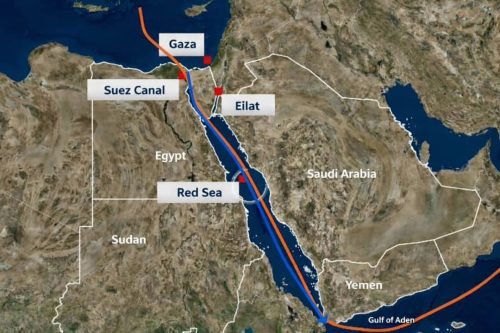
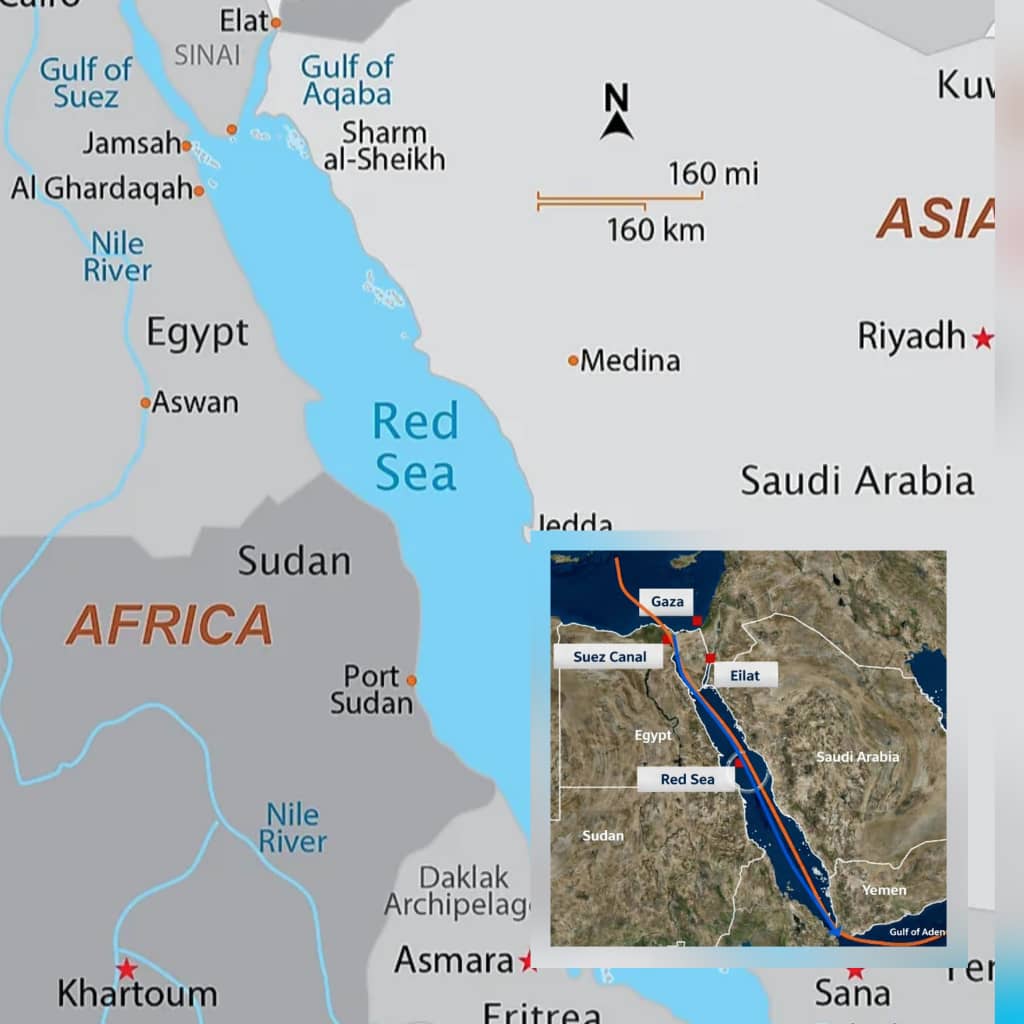
However, analysts believe that the real problem and danger to navigation in the Red Sea – with its ports and passages such as Bab al-Mandab and the Suez Canal – lies in the circulation by official Israeli media of European and American trends with Israel to adopt the project of transporting the sea-land energy, which is represented by shipping energy via ships from the port of Yanbu to the port of Eilat, then transporting it overland via a pipeline from Eilat to the port of Ashkelon overlooking the Mediterranean Sea, from which other ships are loaded in the Mediterranean Sea to deliver it to Europe and America .
A few days ago, an Israeli news platform called “Yom HaYom” announced the return of an old project to the forefront of discussion in light of the tensions related to the Strait of Hormuz. The project is based on turning Israel into a land corridor for transporting oil between the Gulf and Europe, relying on infrastructure that is partially already in place.
The platform says that the opportunity to realize this project is favorable in terms of geographical and environmental reality, but it is almost impossible in terms of creating regional and international tensions in terms of conflicting interests. There is also a security problem that hinders the adoption of this project, in addition to the non-converging political trends between Saudi Arabia and Israel .
Analytical Conclusion :
If the Western world actually adopts the energy supply project via the land corridor from the Red Sea to the Mediterranean, and the Kingdom of Saudi Arabia agrees to implement it, this will primarily have a negative impact on the Suez Canal corridor and the “ SUMED ” pipeline in the Arab Republic of Egypt, since the “ SUMED ” pipeline, which extends from the Gulf of Suez to the Mediterranean, already transports energy, and with the adoption of the new corridor it will be neutralized, and here Egypt will not stand silently with its hands tied .
In addition to Bab al-Mandab, which became isolated and neutralized from the very first moment Saudi Arabia shifted its energy exports from the eastern ports to the port of Yanbu, its importance as a strategic shipping lane is now limited only to East Asian countries, and will not affect, negatively or positively, the energy supply to Europe and America .
Consequently, the ports of the Horn of Africa will become relatively isolated from the new energy supply lines, and their reception of ships as stations for shipping, storage, rest and oil change operations will decrease. In the long term, they will become isolated from commercial shipping routes and maritime navigation as a whole, given the negative and positive impact of energy supply lines on global trade .
From here, navigation in the Red Sea will begin to shuffle the cards and create new alliances between the countries of the region, given the changing interests according to the policies of the Red Sea. In other words, we are approaching a stage of new formations of alliances between the countries of the Middle East and the Horn of Africa. These alliances are based on pragmatism and stem primarily from the geostrategic changes of the countries of the Red Sea and maritime trade routes, and may develop from mere political alliances into a frightening conflict .