


Analysis from the Century Vision Horn (HAPC):
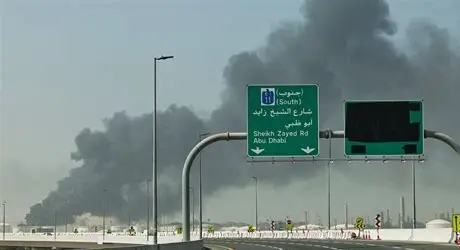
In recent days, the United Arab Emirates was subjected to missile and suicide drone attacks by Iran. Despite these attacks, which have been repeated for several days since the start of the conflict between Iran on one side, and the United States and Israel on the other, the UAE has not responded militarily to the Iranian aggression. This has raised numerous questions about the reasons for the UAE’s lack of a military response to the Iranian aggression. Public opinion on the reasons for the UAE’s restraint is varied. Some believe that the UAE does not possess the necessary power to counter the attacks and therefore does not want to be drawn into the war as an official party. Others suggest that the UAE is simply exercising restraint in order to find peaceful means to de-escalate the regional situation, which appears to be heading towards a protracted war, dismissing the notion that it lacks the capacity for military confrontation. The question remains: Is it reasonable for the UAE to maintain such composure while its territory is under missile attack?
Key Official Emirati Statements Regarding Iranian Attacks on Its Grounds :
On the political front, the United Arab Emirates expressed its strong condemnation through statements, declarations, and denunciations by some of its ministers, most notably the condemnations of the official spokesman for the UAE Ministry of Defense, Abdul Nasser Al-Humaidi, who confirmed, speaking via CNN Arabic , that the UAE has not and will not accept under any circumstances any infringement on its sovereignty, security, and territorial integrity, and that the state reserves its full right to take all necessary measures to respond to any aggression against it .
Al-Humaidi added: “We also affirm that the UAE is at the highest level of readiness, and possesses the capabilities and defense and armament systems, including national industries, that enable it to defend its territory and protect its people, regardless of the time frame and length of the escalation in the region .”
Al-Humaidi revealed that the UAE possesses diverse, integrated, and multi-layered air defense systems capable of countering various aerial threats with high efficiency, and also has a strategic stockpile of ammunition.
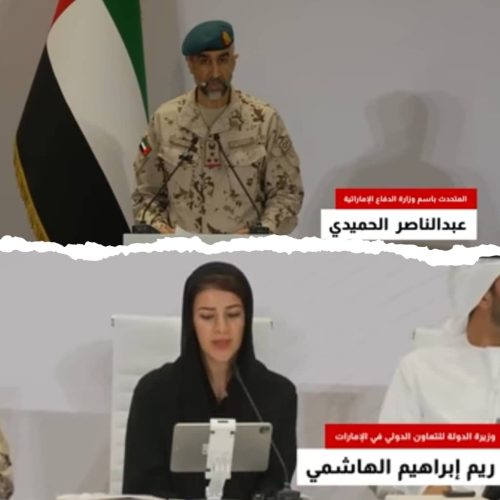
In the same speech, Defense Minister Al-Humaidi reviewed video footage showing the interception by UAE air defense aircraft of the F-16 and Mirage 2000 type of Iranian attacks represented by helicopters and drones .
In the same context, Reem Al Hashimi, UAE Minister of State for International Cooperation, stated that in recent days the UAE, along with sisterly and friendly countries, has been subjected to a series of blatant Iranian attacks in the context of a dangerous and unprecedented regional escalation, without taking into account the UAE’s clear position, which it has repeatedly affirmed, that it will not allow its territory to be used for any military operation against Iran .
She stated: “While the UAE renews its call for restraint, prioritizing serious and responsible dialogue, and diplomatic solutions to overcome the current crisis in a way that ensures security, stability, and prosperity for the peoples of the region, it emphasizes its full and legitimate right to self-defense in response to attacks, in accordance with Article 51 of the Charter of the United Nations .”
The Military Capabilities of the United Arab Emirates :
What matters here is identifying the offensive and defensive military capabilities of the United Arab Emirates, its strategic stockpile of weapons, and the extent of technological development of its defense systems, in order to arrive at a clear vision that supports or refutes what is being circulated in public opinion about the current calm position of the United Arab Emirates despite the presence of aggressive Iranian attacks against it.
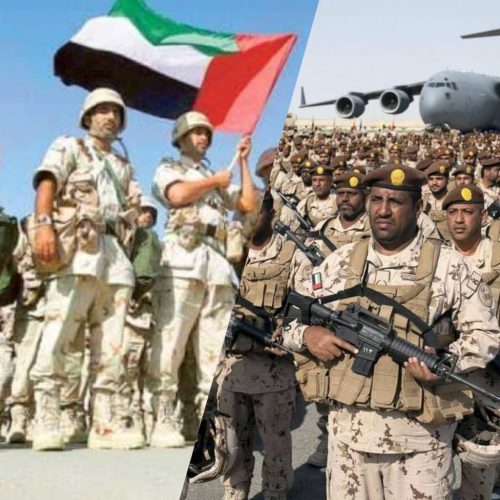
According to international reports on the UAE’s military and strategic strength, it ranks 54th out of 145 countries in the 2026 global military power rankings. These capabilities include the following :
- Ground Forces: It consists of 44,000 soldiers, with two armored brigades, two mechanized infantry brigades, one infantry brigade, one artillery brigade, two air defense brigades, and three air defense missile brigades .
- Air Force: The UAE Air Force has 7,000 soldiers, with 6 squadrons of fighter and bomber aircraft .
- The Naval Forces: The UAE Navy has 3,000 soldiers, with a fleet of warships and boats .
- Air Defense: The UAE’s air defense systems are diverse, integrated, and multi-layered, capable of countering various aerial threats with high efficiency .
- THAAD system : For the UAE, this system represents one of the main pillars of deterrence against any attack, and is also an essential part of an integrated, multi-layered defense system; it is one of the most advanced air defense systems in the world, as it enables the interception of ballistic missiles in the upper atmosphere, thus raising the level of protection against advanced strategic threats . It includes a radar and a single-stage interceptor missile capable of hitting and destroying the target, to deter ballistic missiles inside or outside the atmosphere .
- Defense Industries: The UAE is working on localizing defense industries, producing drones, warships, and multi-mission combat vehicles .
Conclusion :
The review of the UAE’s military strength , along with the statements and declarations of its Minister of Defense and Minister of State, shows that its position on the escalation so far does not represent weakness. Rather, the UAE is capable and efficient in repelling any military aggression against its country and responding in kind, but it reserves the right to respond while taking into account the pursuit of diplomatic means to reach solutions, and is doing its utmost to avoid further inflaming the already volatile situation in the region .
Despite being subjected to aggressive attacks by Iran, it is exercising restraint, striving to be among the countries calling for a halt to the escalation, and to take on the role of mediator to reduce the repercussions of the ongoing war in the region, according to what was stated by Minister of State Reem Al Hashemi.