



Juba|Forum of Horn Vision"HAPC"
Saturday|June6,2026
In a move described as a major boost to the national economy, the leading oil operator, GPOC, which represents the largest oil consortium in South Sudan, has achieved an unprecedented production jump , its highest in nearly two decades.
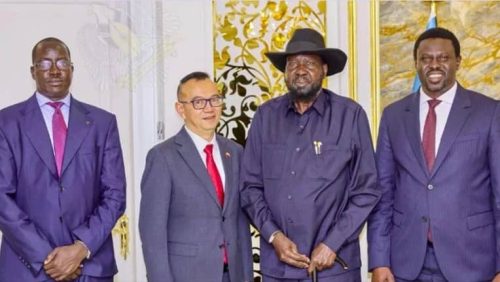
A scene from President Salva Kiir’s meeting with officials from the leading operating company
Following a high-level meeting with energy sector leaders, President Salva Kiir’s office announced a sharp rebound in production levels, reaching 60,000 barrels per day, compared to approximately 44,000 barrels previously . This is the highest rate the company has seen since commencing operations in the country in 2005, giving Juba a further boost of optimism regarding its financial recovery.
Distribution of Shares and Privileges within the Larger Alliance:
“GPOC” operates extensive exploration and production activities in oil blocks 1 and 4S , which include strategic fields such as Al Wahda , Toma South, Al Tor, and Al Manja . This international consortium consists of:
China National Petroleum Corporation (CNPC): The largest shareholder with 40%.
Petronas Malaysia: 30 %.
ONGC India: 25 %.
Nilepet National: Representing the state with a 5% stake.
The Importance of the Breakthrough: an Attempt to Heal the Wounds of War:
This production surge comes at a very sensitive time, as Juba is trying hard to compensate for the huge losses suffered by the energy sector as a result of the civil war and security disturbances that followed the secession from Sudan in 2011. It is worth noting that the country’s production was between 350,000 and 400,000 barrels per day before the conflicts of 2013.
Why is Oil a Matter of Life or Death for South Sudan?
The government’s general budget depends almost entirely on crude oil revenues, which are the primary source of funding for the treasury and foreign currency reserves . Therefore, any increase in oil production directly impacts the stability of the domestic economy.
Export challenge: Geopolitics dictates its terms:
Despite this digital achievement, South Sudan’s biggest challenge remains “geography”. The landlocked country lacks any sea access and relies entirely on Sudanese infrastructure and pipeline networks to transport its production to global markets via Bashayer Port on the Red Sea coast.
The main transport artery extends for more than 1,500 kilometers from the Melut Basin (Upper Nile State) to the Sudanese ports, in addition to another line linking Unity State to the same destination, making the continuation of this regional cooperation a prerequisite for translating the production boom into tangible financial returns.